


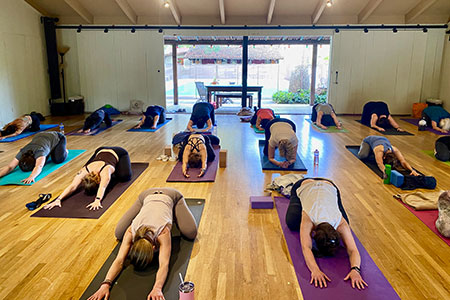
A yoga retreat is an immersive experience, typically lasting between 3 and 14 days, or sometimes just 1 day for a day retreat, that combines daily yoga and meditation practices with elements of wellness, nature, travel, cultural experiences, and time for rest and rejuvenation. Unlike attending a local yoga class in a studio or online, a retreat helps you to completely disconnect from your daily environment and responsibilities, and creates ideal conditions for real transformation and renewal. There are yoga retreats worldwide, usually hosted in beautiful natural environments.
Retreats vary in style, format, focus and cost. Some retreats are held at dedicated retreat centers, whilst others at boutique hotels, eco lodges or private villas. Some retreats are more physically active, combining yoga with hiking, surfing, or cycling, whilst others are more restorative with an emphasis on meditation, breathwork and silence. Understanding the type of yoga retreat you are looking for before you start searching will save time and help you ro find an experience that aligns with your intention and health goals.
It's helpful to be familiar with the style of yoga offered at the retreat you choose to attend. You may prefer to choose a retreat that matches the style you currently practice, or you may be open to learning different styles of yoga and deepening your practice. Here are the most common styles you'll encounter at a yoga retreat.
A gentle, foundational style that works well for beginners and those looking for a slower pace. Hatha yoga classes focus on holding basic yoga postures for several breaths, combined with slow deep breaths.
A more dynamic, flowing style of yoga that links movement with breath. Retreats that offer Vinyasa flow yoga classes suit those with some yoga experience who enjoy a more physically active practice, usually with faster movements between the postures than Hatha Yoga. Many retreats offer both a morning Vinyasa and Hatha yoga class and an evening restorative or yin yoga class, creating balance.
A deeply passive yoga style where poses are held for 3–5 minutes, focused on lengthening and relaxing connective tissue and fascia. Yin Yoga is excellent for stress relief, flexibility, and emotional release. It is often offered during a yoga retreat as a complementary evening practice alongside more active morning Vinyasa or Hatha yoga.
The most gentle style of yoga, using props such as bolsters, blankets and blocks to fully support the body whilst relaxing in a passive posture. Restorative yoga is ideal for those recovering from injury, dealing with stress or burnout, or seeking deep nervous system rest. Many wellness retreats incorporate restorative yoga as a core component.
The instructor is one of the most important factors in the quality of your retreat experience. A beautiful location with a teacher you don't connect with may not be as positive an experience as a simple setting with a teacher you love. Here are a few recommendations for things to look for.
Yoga teachers must have completed at least a 200-hour Yoga Teacher Training (YTT) from a Yoga Alliance registered school. It can also be beneficial if they have been teaching for many years, and have studied with multiple teachers as this demonstrates an openness to learning, and hands-on experience of, different styles and techniques. This level of experience brings a depth of knowledge and confidence and is particularly important in a retreat environment where there are usually varying levels of practitioners.
It's helpful to attend a retreat with a leader that has prior experience leading and hosting retreats as this is an entirely different skillset from teaching yoga classes. Learn about the teacher's retreat leadership style, and their approach in facilitating a group to find out if it will be a good fit.
Read reviews carefully and look for details in the reviews. Generic praise such as "amazing retreat!" tells less than specific detail, for example "Sally is an intuitive and inspiring teacher whose classes are designed so that everyone feels both comfortable and challenged". Also, look for testimonials that describe the instructor's teaching quality and style of retreat leadersihp and coordination, not just the location or accommodation.
Instructors who have been featured in established wellness publications or media have had their experience and retreats validated by teams with professional standards. This can be a meaningful signal of credibility. In addition, it's helpful to check their social media channels and read customer comments and public reviews. It's also a great idea to watch some online videos of the instructor teaching a yoga class or leading a guided meditation. You can view free yoga class videos by Sally Mitchell on the Body Flows YouTube channel.
The location sets both the physical and emotional backdrop for your retreat experience. The right location for you depends on several factors. Here are some considerations when choosing where to travel for your yoga retreat experience.
Consider how much of your retreat time you are willing to spend traveling. A local retreat, within 2-3 hours of home, means you arrive fresh and relaxed. An international retreat adds jet lag and travel fatigue, yet it may offer a more complete removal from your busy daily life and a more culturally diverse experience, which for many people is exactly the point of a retreat!
Research the climate at your destination during the retreat dates. Mediterranean destinations such as Greece and Portugal are ideal in late Spring, early Summer and Fall, when they are warm yet not too hot. Mountain destinations such as Sedona and Lake Tahoe are best in late Spring and early Fall when temperatures are comfortable for hiking. Scotland is beautiful in Summer when daylight extends until 10pm. Sonoma California yoga retreats offer a moderate climate all year!
Consider the type of natural environment that replenishes you the most. Ocean and coastline, mountains and forest, high desert, or wine country. Each creates a distinctly different energetic experience. A retreat in Santorini overlooking the Aegean caldera feels entirely different from an alpine hiking and yoga retreat in Lake Tahoe California, even if the yoga classes are the same. Choose a setting that genuinely excites you because the anticipation and the environment itself are part of the healing and transformation you will experience.
Clarify exactly what is and is not included in your retreat package price before booking. A well structured retreat will clearly specify the following.
Yoga retreat pricing varies enormously, from around $500 for a budget domestic weekend retreat to $5,000+ for a luxury international experience. Here's a general guideline for understanding what different price points typically deliver.
Typically domestic, dormitory or shared room accommodation, sometimes camping or glamping, basic vegetarian meals, minimal organized activities beyond daily yoga classes. This is ideal for those new to retreats who want to experience the format without a large financial commitment, and are looking for plenty of free time to relax, journal and rest.
Private or semi-private accommodation, higher quality meals, organized excursions included, more experienced instructors. This is the sweet spot for many retreat-goers as there is enough comfort and quality to genuinely relax without the premium of luxury pricing.
Boutique hotel or private villa accommodation, gourmet cuisine, highly curated excursion program, instructors with significant international reputation. These retreats are appropriate for those who want a truly exceptional, all-inclusive experience where all retreat logistics are handled.
When comparing prices, it's recommended to calculate the cost per day and confirm what's included before making direct comparisons. For example, a $3,000 retreat that includes all meals, daily excursions, and private accommodation may end up being better value than a $1,500 retreat where accommodation, meals, and transfers are all additional cost.
Group size is one of the most personal factors in choosing a yoga retreat, and the right size depends on the kind of experience you're looking for. There is no universally better option. Small and larger groups each offer different yet valuable experiences.
Smaller group retreats create a quieter, more introspective atmosphere. If you're going through a significant life transition, prefer silence and solitude, or are looking for an experience that feels more like a private retreat, a smaller group could be a good fit.
Larger group retreats bring a more vibrant, social energy that many retreat-goers find deeply nourishing, particularly those traveling solo who want to meet a a variety of like-minded people. An experienced retreat leader is able to create intimacy, even within a larger group, ensuring that every participant feels supported and connected throughout the retreat. Many retreat-goers find that the friendships formed during the retreat are amongst the most meaningful of their lives because the shared mindful experience creates bonds across a diverse mix of backgrounds, ages and personalities.
Our Body Flows retreats typically welcome between 15 and 40 participants depending on the destination, and the consistent feedback from our alumni is that the group energy is one of the highlights of the experience. As one participant noted after our Sonoma retreat, "The group was awesome professional women from a variety of backgrounds. I love that we practiced yoga and meditation together but also had time to explore on our own or in small groups."
The best retreat for you is one where the destination, the itinerary, the group atmosphere and the leader's experience all align with the type of experience you are seeking, whether that's quiet reflection or vibrant connection!
1. What yoga styles does this retreat include, and is it suitable for my experience level, whether complete beginner or experienced yoga practitioner?
2. What is included in the price, meals, accommodation, excursions, transfers, and what will I need to budget for separately?
3. What is the daily schedule from morning to evening, and how much free time is built in?
4. Is this retreat appropriate for someone with a specific injury, physical limitation or health condition?
5. Can you accommodate my dietary requirements such as vegetarian, vegan, gluten free, dairy free or other?
6. Will our group have exclusive use of the venue, or will other guests be present during the retreat?
7. What is your yoga training and teaching background and how many retreats have you led?
8. What is the group atmosphere like? Is it a social, energetic experience or a quieter, more introspective one?
9. What airport should I fly into, and are transfers to the venue included?
10. What is your cancellation policy, and what happens if the retreat is cancelled by the retreat leader?
Sally Mitchell has been leading yoga and wellness retreats for over 12 years across California, Sedona and internationally, from Greece and Scotland to Portugal and Costa Rica. All levels are genuinely welcome. Join a vibrant community of like-minded travelers and yogis from around the world! Read our testimonials here.
No, the majority of yoga retreats are genuinely suitable for all levels, including complete beginners. Look for retreats that explicitly state "all levels welcome" and confirm with the instructor that modifications will be offered. An experienced teacher can adapt every class for participants with a wide range of experience.
A long weekend (3–4 days) is ideal for a first retreat. It's long enough to truly relax and settle into the rhythm of the experience without feeling like a major commitment. Once you've experienced your first retreat, many people naturally want longer, and a 5-7 day retreat becomes the preferred length for many retreat-goers.
Absolutely! Solo travelers make up a significant portion of most retreat groups, sometimes 40–60% of participants. Retreats naturally create connection between participants through shared meals and excursions. Most solo attendees report that attending alone was one of the best decisions they made, as many of our solo retreat attendees share in our testimonialsas it allowed them to take time to themselves as well as meet new friends.
Comfortable clothes for yoga and hiking, layers for cooler mornings and evenings, walking shoes for excursions, a reusable water bottle, a journal, any personal medications and travel documents. Some retreats provide yoga mats and props. Check with your retreat organizer for the packing list recommendations for specific retreats.
Look for testimonials with names and dates, Google reviews, instructor credentials, media coverage from established publications, a clear and fair cancellation policy, and specific accommodation details. Speaking directly with the instructor before booking is always a good idea as it indicates they value personal connection. Speak with Sally directly.
A yoga retreat is a personal experience where you attend as a student to practice, rest, and rejuvenate. A yoga teacher training (YTT) is a professional certification program where you study and learn to become a qualified yoga teacher. They are entirely different experiences. Retreats are for anyone to enjoy and relax, whilst teacher training programs are for those who want to learn how to teach yoga, and study ancient yoga texts.
Learn about the benefits of attending a life-changing yoga retreat.
Sally Mitchell is the founder and lead instructor of Body Flows Yoga Retreats, with over 16 years of yoga teaching experience and 12 years leading retreats worldwide. Current retreat destinations include California, Sedona, Greece, Scotland and Portugal, with new retreats launching in Spain, Japan, Norway, Bali and New Zealand. Sally has also led past retreats in Costa Rica, Mexico, Hawaii, Colorado and Oregon. She holds an E-RYT 200 Yoga Alliance certification and is also a Certified Massage Therapist, Reiki Practitioner, ChiRunning and ChiWalking Instructor, and Integrative Nutrition Health Coach. Sally has been featured in CBS, Shape Magazine, Woman's Day, EverydayHealth and numerous wellness publications. She is passionate about creating transformative retreat experiences that combine yoga, meditation, hiking, cultural immersion and genuine human connection for all levels.
A personal story of discovery as Sally shares life-changing benefits of attending a yoga retreat.
Read Article
Tranquil lochs, historic castles and Celtic wisdom. Practice yoga in ancient Scotland.
Read Article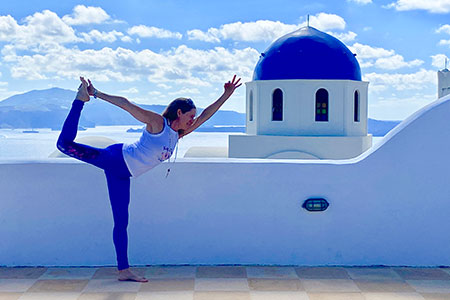
Step onto one of the most beautiful and magical Greek islands for a rejuvenating retreat.
Read Article